Jasser Kraiem

I'm a [degree] student in [program] at the Technical University of Munich. I'm interested in probabilistic generative models and learned image compression — how models represent images, and how little information they need to do it.

This page collects what I have written and worked on. I'll be at Shanghai Jiao Tong University for an exchange semester from [term], and I'm looking for a small research project there — get in touch.

Research

End-to-End Learned Image Compression: Approaches, Deployment, and Standardization

Jasser Kraiem, Zongxie Chen

Seminar paper, Chair of Media Technology, Technical University of Munich · 2026
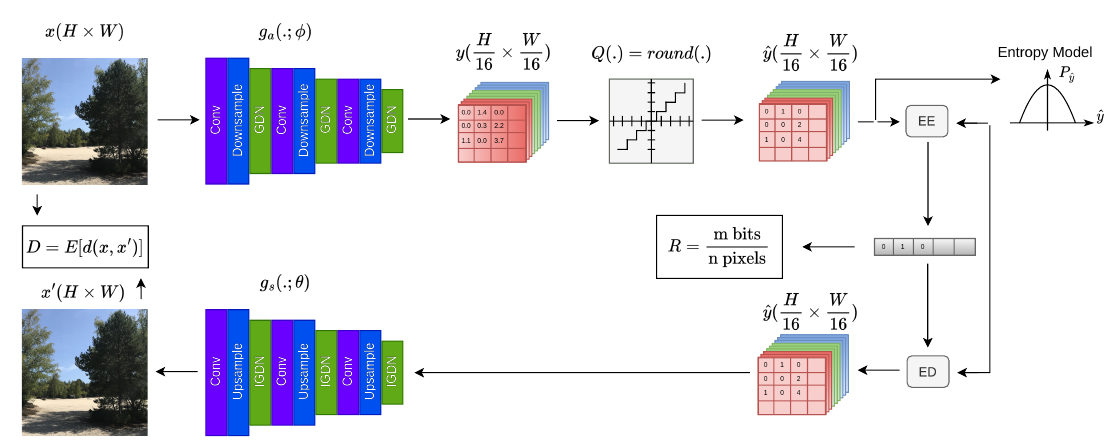
Inference pipeline of the VAE-based codec: analysis transform, quantization, entropy coding with a learned entropy model, and synthesis transform.

A review of learned image compression (LIC): the VAE-based framework most models build on, advances in transforms, quantization and entropy modeling, and perceptual compression beyond rate–distortion. Representative models are benchmarked on a Tesla T4 GPU to assess practical deployability, and the JPEG AI standard is examined. Standardization is promising, but future work has to balance compression performance against deployability, for instance through adaptive compression.

Writing

From Probabilistic Modeling to Generative Modeling — a six-part series building up from probability basics to diffusion models, with derivations and code.

  1. 01
    Probabilistic Generative Models Overview

    An introduction to probabilistic generative modeling: how generative models differ from discriminative ones, and the concepts behind five key model families.

    7 Mar 2026

  2. 02
    Gaussian Mixture Models Explained

    Gaussian Mixture Models express a probability distribution as a weighted combination of Gaussians, capturing multi-modal data through interpretable components.

    8 Mar 2026

  3. 03
    Variational Autoencoders Explained

    A Variational Autoencoder (VAE) is a generative model that learns a compressed, continuous representation (a latent space) of data. It consists of an encoder network that maps data to a distribution in the latent space and a decoder network that reconstructs data from samples drawn from that latent distribution.

    12 Mar 2026

  4. 04
    Normalizing Flows Explained

    Normalizing Flows turn a simple Gaussian into a complex distribution through invertible transformations, enabling exact and tractable likelihood computation.

    15 Mar 2026

  5. 05
    Generative Adversarial Networks Explained

    How GANs learn by pitting a generator against a discriminator — the minimax game, and why adversarial training replaced explicit density estimation.

    19 Mar 2026

  6. 06
    Diffusion Models Explained

    How diffusion models generate images by reversing a gradual noise process — forward and reverse Markov chains, DDPM, and why they rival GANs on sample quality.

    21 Mar 2026